IndieWeb
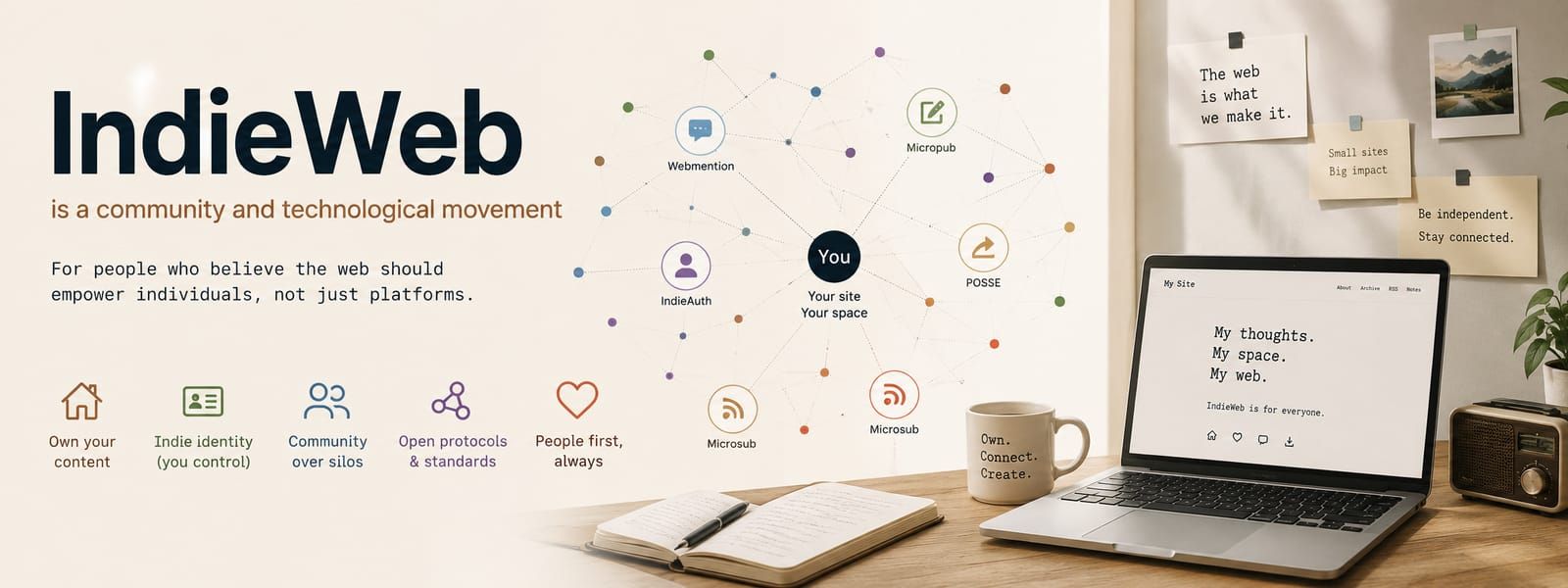
The IndieWeb is more than just a community or a set of technical standards; it's a philosophy of digital independence in an era of data consolidation. At its core is the radical idea that you should own your words, your relationships, and your identity online — not rent them from a corporate platform that can change its terms, disappear overnight, or algorithmically decide who sees your content. From this mission, a distinct technical strategy has emerged: POSSE (Publish on your Own Site, Syndicate Elsewhere). Instead of handing your primary content over to social media silos, you publish first on your personal domain — the canonical source you control — and then syndicate copies or summaries out to services like Mastodon, Bluesky, or X. This ensures that even if a platform vanishes, your digital legacy remains intact and fully under your command.
Who is Tantek Çelik? The Architect of the IndieWeb Movement
To understand the IndieWeb is to understand the foundational contributions of Tantek Çelik — a Turkish-American computer scientist whose fingerprints are woven into the very fabric of the open web. While not a sole creator, he is one of its most essential architects: a co-founder of IndieWebCamp, the founder of microformats.org, and the long-time Web Standards Lead at Mozilla. His career spans decades of work that have quietly shaped the technologies we all rely on, from early contributions to CSS specifications at the W3C to leading the development of Internet Explorer for Mac's Tasman rendering engine at Microsoft. But his most profound legacy lies in his relentless, principled fight against the centralization of the web.
What makes Çelik invaluable to the IndieWeb is his unique ability to unite technical rigor with a deep ethical conviction. He doesn't just build tools; he articulates a vision. In his landmark talk, "Take Back Your Web," he delivered a galvanizing call to action, framing the IndieWeb not as a niche hobby for developers, but as a necessary people-focused alternative to what he terms the "corporate web" — an antidote to walled gardens where users are the product. He lives this philosophy daily, using his own site, tantek.com, as a living laboratory for POSSE, manually syndicating his notes, replies, and photos to multiple silos while always keeping the canonical version on his own domain.
Core Technical Contributions: The Building Blocks of Independence
Çelik's contributions are not merely ideological; he is the creator of the essential infrastructure that makes the IndieWeb work. Before you could easily own your data, you first needed a way to give that data meaning and a way for sites to talk to each other. He solved both problems:
Microformats: The "Lowercase Semantic Web": Long before Schema.org or complex RDF graphs, Çelik pioneered microformats — simple, human-readable HTML classes that add structured meaning to everyday web content. By adding a class like h-card to a div, you can mark up a person's contact info. With h-entry, you mark a blog post. With h-feed, a stream of content. Çelik famously called this vision the "lowercase semantic web" — a pragmatic, grassroots way to embed rich data into ordinary web pages without requiring specialized databases or buy-in from big tech. This humble standard became the bedrock of the IndieWeb, enabling everything from webmentions to content discovery. He later proposed and developed microformats2 in 2010, a major update that simplified the syntax and made the system even more robust, ensuring it could scale with the movement's ambitions.
Webmention: The Notification Layer of the Independent Web: If microformats gave content meaning, Webmention gave the independent web its pulse. Çelik is credited as the inventor of the concept that evolved into Webmention, a simple protocol that allows one website to send a notification to another when someone links to it, replies to it, or otherwise interacts with it. Crucially, Webmention is the decentralized successor to Pingback — but unlike Pingback, it handles not just links but any kind of interaction, like likes or reposts. This protocol is the engine behind cross-site conversations on the IndieWeb, allowing a comment left on your friend's blog to appear as a reply on your own site, federated across independent domains without a central server. Without Webmention, the IndieWeb would be a collection of isolated islands; with it, those islands can talk, forming a true, resilient web.
More Than Technology: The Ethical Framework
Çelik's leadership extends beyond code to define the very ethics of the community. Under his guidance, the IndieWeb has adopted a strict, non-negotiable Code of Conduct that enforces an inclusive, harassment-free space for everyone, regardless of identity or background. He has also been a vocal proponent of privacy, with his projects at Mozilla and within the IndieWeb consistently championing user rights over corporate surveillance. In an age of predatory AI data-scraping, omg.lol — a service that embodies the IndieWeb spirit — has made a public commitment to never use its users' data to train AI models, a stance that reflects Çelik's broader ethical framework of building tools that respect, rather than exploit, their users.
Ultimately, Tantek Çelik is not just a builder; he is a synthesizer and a steward. He took the disparate threads of independent blogging, open standards, and personal data ownership and wove them into a cohesive movement. He gave it a name, a set of principles, the technical protocols to operate, and perhaps most importantly, a moral compass. To the IndieWeb, he is not merely a contributor or a founder — he is the architect of its soul, the person who envisioned a better web and then spent over a decade methodically, patiently, and passionately building the pieces to make it real.
This page was automatically generated as a result of AI research conducted across 26 web pages.