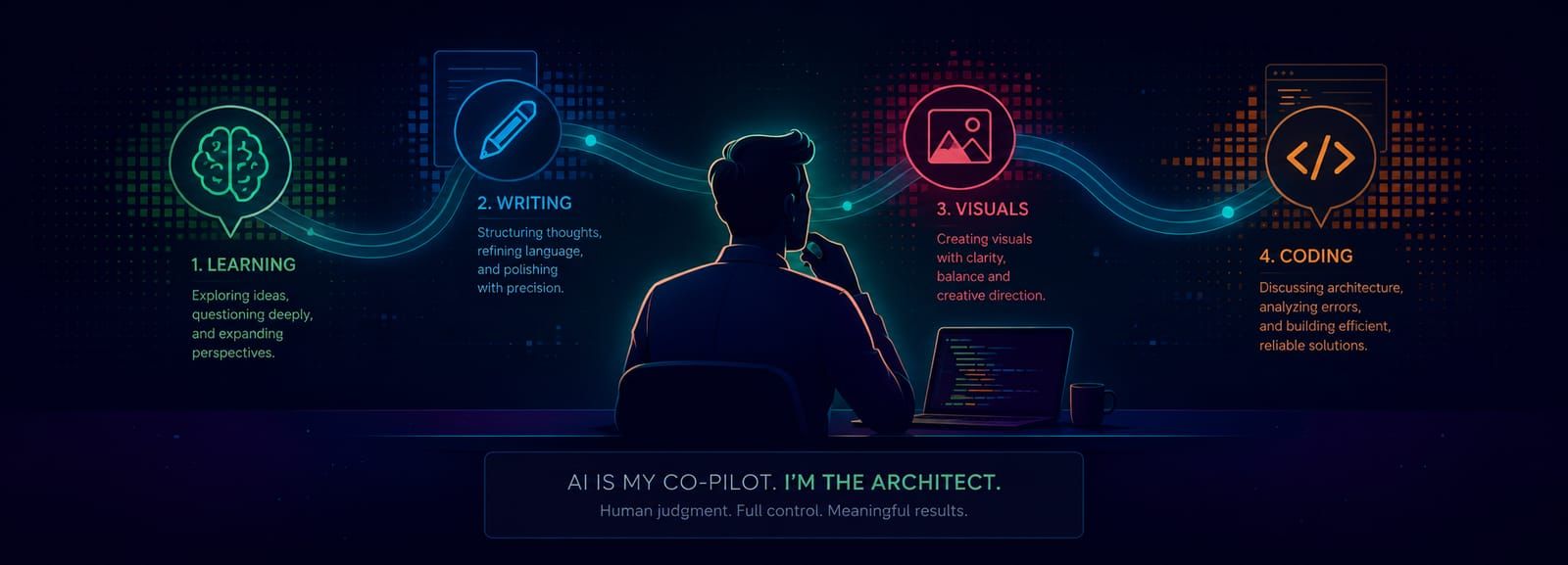
AI Is My Co-Pilot
My AI Collaboration Model
When integrating artificial intelligence into my workflows, I adopt a human-centered approach where control and final responsibility always remain with the individual. I do not view AI as an autonomous decision-maker, but rather as a supportive system that enhances productivity, accelerates thinking, and assists technical and creative processes.
1. Intellectual Development and Learning
I use LLMs (Large Language Models) not merely as information sources, but as thought partners for testing ideas and exploring concepts from multiple perspectives.
Through dialogue with these models, I deepen my understanding of complex subjects, challenge assumptions, and develop broader analytical perspectives during the learning process.
2. Writing and Editorial Work
In written production, I position AI as a “final editor” rather than a primary author.
Structure and Language Refinement
Organizing rough drafts, improving readability, correcting grammar and punctuation, and strengthening textual flow.
Translation
Translating content into English while preserving meaning, tone, and conceptual integrity.
Final Review
Performing final consistency and readability checks on texts that have already passed through my own evaluation process.
3. Visual Creation and Illustration
I leverage AI-assisted tools to produce illustrations and visual assets, particularly for web-based projects.
Using carefully designed prompts and creative direction, I utilize these systems for:
- visual generation,
- background adjustments,
- lighting and composition refinement,
and technical retouching processes.
4. Coding and Technical Analysis
In software development, I strongly prioritize the principle of maintaining full human oversight. For this reason, I do not allow AI systems to directly modify my codebase through terminals or IDE integrations.
Instead, I use AI as a supporting tool in the following areas:
Architectural Discussions
Exploring software structure, system design decisions, and alternative implementation approaches.
Error Analysis
Understanding root causes behind error messages and evaluating possible solutions.
Productivity
Rapid generation of repetitive or boilerplate code within standards and constraints that I explicitly define.
I believe AI-generated outputs are often fast but inherently average in quality. My goal is to combine that speed with human engineering judgment, technical experience, and critical evaluation in order to produce more reliable, maintainable, and sustainable results.
Conclusion
I see artificial intelligence not as a replacement for human capability, but as a powerful augmentation tool that can accelerate thought, support production, and significantly improve efficiency when used responsibly.
Final judgment, direction, and accountability, however, should always remain in human hands.